
The Opening Statements
Brian Walshe's defense offers a (very) desperate explanation

Brian Walshe appeared ready for the trial. His appearance, as expected, was neat. He was dressed in a smart blue suit, his hair neatly cleaned back. Gone was the odd haircut he once sported. He was clean shaven and seemed a bit more slim than he did in the past. He appeared to be focused and engaged, writing notes at the defense table and paying close attention to the judge as she spoke to the newly seated jurors.
But what stood out to me was his that he appeared tired. His eyelids seemed heavy. Perhaps this shouldn’t be a surprise. He is a defendant about to watch a trial for his life. He is also a man who has recently admitted to transporting his wife’s dead body and lying to the police. The stakes are high, and the odds against him are even higher.
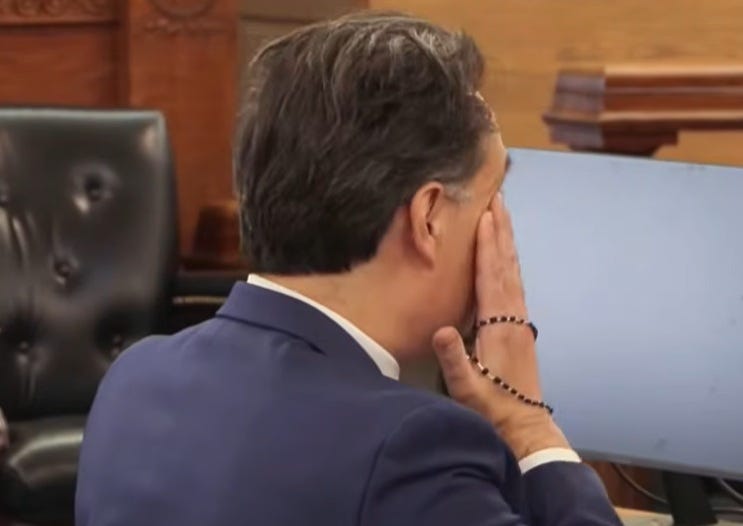
Another sign that Brian Walshe is hoping against hope that the jury will buy whatever his defense team can muster came just after the judge’s opening instructions to the jury. As he rubbed his weary face, what appeared to be a set of Rosary beads could be seen wrapped around his right hand.
The Prosecution’s Opening Statement
It is common knowledge by now that Brian Walshe made a number of strikingly incriminating internet searches. But listening to Norfolk County Assistant District Attorney Gregory Connor read each of them aloud was nevertheless effective. It’s hard to overstate just how damning they are. And when D.A. Connor moved on to the defendant’s actions in the hours after Ana was last seen alive (at about 1 a.m. on New Year’s Day), it’s easy to see why the defense decided to plead guilty to at least some complicity in what happened to Ana. His presence in Swampscott, Massachusetts, in the vicinity to his mother’s home, and the ultimate finding of materials that undeniably belonged to Ana (including her COVID vaccination card) aren’t easily overcome. It was a neatly presented recitation of astounding behavior on the part of Walshe.
The Defense’s Opening Statement
The defendant’s counsel, Larry Tipton, opened by admitting to the guilty behaviors of his client and the “dark subject matter” that he searched “as he wrestled with the fact that Ana Walshe was dead.”
Then came the excuse. Tipton stated that when Brian Walshe returned to bed after going to clean the kitchen during the night, he found his wife unresponsive. In a panic, it was claimed, Walshe couldn’t make sense of the fact that his wife, whose body then fell off the bed, was dead. Why? Because of a “sudden unexplained death.” It could be “pulmonary” or “electrical,” Tipton told the jury, but the evidence will show that it does sometimes happen. “To this day, it is not well understood,” Tipton asserted, in a vast understatement.
The attorney also admitted there was some stress in the marriage. Ana’s commute, Brian’s federal conviction, child care—these all led to some problems. And there was an affair between Ana Walshe and William Fastow, a real estate broker in Washington, D.C., the man who sold them a townhouse in that city. She admitted to Brian that she had a crush on Fastow and even mentioned divorce to him, the attorney claimed. But no matter—Brian wasn’t jealous and Ana did mention preserving her family. And Tipton stated that the Walshes had no financial difficulties.
No, everything was fine, Brian loved Ana, and Ana loved him, too. “You will hear how she described Brian as her best friend,” he said.
So, what we have is a very desperate defense strategy. Tipton will essentially argue that though his client’s searches included queries about disposing a body “after a murder,” and despite Ana’s extramarital affair, the truth is that the marriage was strong, finances were solid, and this otherwise healthy woman simply died of a “sudden unexplained death.” He merely panicked. He didn’t call 911. He didn’t think “What happened to my beloved wife? She must be autopsied!” No, he began plotting to dispose of her body.
“Brian Walshe never killed anybody,” Tipton closed. And this is what he hopes the jury will believe.
It’s an unenviable gambit, to say the least. But it takes just one juror to buy it. Sound unlikely? I thought so. But during the morning break, I checked CourtTV’s live feed and an online poll with 700+ respondents showed that 14% of viewers found Tipton’s version of events more compelling than the prosecution’s.
Hopefully there are some widows or widowers on that jury. Caregiving a terminally ill spouse is stressful and watching them die evokes emotions and thoughts too big to describe. None of which are focused on disposing of the body … F Brian Walshe.